
SWaP-C PRECISION TIMING Ultra-Low Power Oscillators (<60 mW) & Disciplined Modules
North Andover, MA USA Tel: +1 (781) 521-5862 info@timecubic.com
TimeCubic Inc.
TimeCubic Product Portfolio 6 Released Product Series: Q40 • Q50 • Q52 • Q69 • Q100 • Q200

Frequency & Precision Timing Solutions

Engineered for SWaP-C constrained applications requiring ultra-low power consumption, high-frequency spectral purity (-175 dBc/Hz), sub-ppb thermal stability, and nanosecond-grade 1PPS holdover across marine, aerospace, telecom, and defense systems.

Parametric Comparison Matrix

Side-by-side comparison of package footprint, power consumption, frequency options, stability, and interfaces.

Released Lineup: 6 Active Series
Model & Series Category Size (mm) Power (Steady) Stability / Noise Frequency Interface / Discipline Datasheet
Model Q40 (Q40L) Miniature Low-Noise RF Oscillator 12.5 × 12.5 × 5.6 <350 mW @ 100M ±150 ppb • -175 dBc/Hz 100 MHz Analog Vc (0–2.8V) Rev C ↓
Model Q50 Ultra-Low Power Oscillator 21.6 × 15.3 × 10.0 <60 mW (55–205 mW) ±10 ppb • Aging opt. 10, 16.384, 100 MHz Analog VCON (0–2.8V) Rev B ↓
Model Q52 / Q52L High-Stability Low-G Oscillator 20.5 × 14.0 × 10.0 75–109 mW ±2 ppb • ±0.3 ppb/g 16.384 MHz VCON / 1500G Shock opt. Q52 ↓ Q52L ↓
Model Q69 / Q69-100M Rapid Warm-Up 1PPS Disciplined Osc. 39.1 × 34.0 × 13.7 135–250 mW (30s warmup) 1 ns RMS • 1000G shock 5 to 100 MHz RS232 ToD + Hitless 1PPS Q69 ↓ 100M ↓
Model Q100 Flagship OBN 1PPS Disciplined Module 39.1 × 34.0 × 13.7 <65 mW (220 mW warmup) 1 ns RMS • ±1 ms/60d 5, 8.192, 10, 16.384M RS232 ToD Telemetry + 1PPS Rev O ↓
Model Q200 Satellite Disciplined Timing Receiver 65.0 × 65.0 × 23.0 3.0 W (@ 5V) 1 ns RMS • ±1.0 μs/24h (@±5°C) 10 MHz (5, 8.192 MHz) RS232 ToD + Lock/Enable Rev J ↓

Featured Hardware Architecture & Specifications

Deep-dive technical overview for each of the 6 released TimeCubic product series.
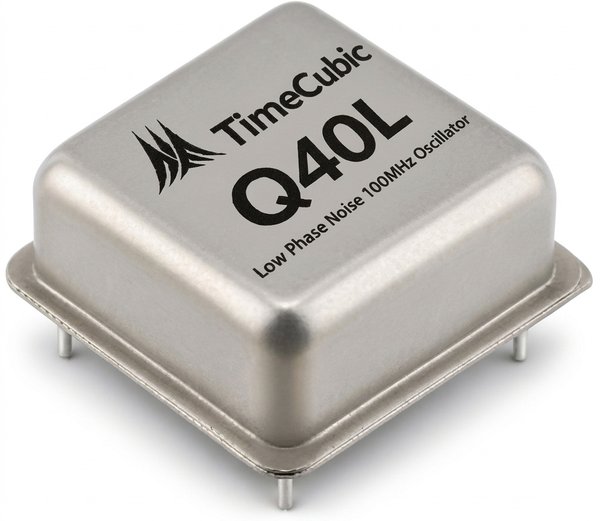
Model Q40 (Q40L)
MODEL Q40 SERIES (Q40L) <350 mW • 100 MHz HCMOS -175 dBc/Hz FLOOR

Q40L-100 Miniature Low Phase Noise Oscillator

Engineered for high-frequency RF applications requiring extreme spectral purity in an ultra-miniature footprint. The Q40 series packs a state-of-the-art 100 MHz oscillator core into a tiny 12.5 × 12.5 mm package, achieving an exceptional phase noise floor of -175 dBc/Hz at 1 MHz offset while consuming less than 350 mW.
PACKAGE 12.5 × 12.5 mm
FREQUENCY 100 MHz
PHASE NOISE -175 dBc/Hz @ 1M
POWER <350 mW (-40~+70°C)
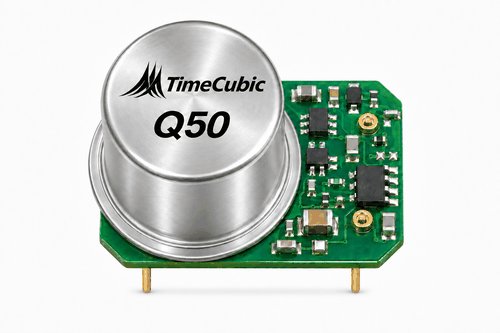
Model Q50
MODEL Q50 SERIES <60 mW ULTRA-LOW POWER

Q50 Ultra-Low Power Precision Oscillator

Engineered specifically for subsea Ocean Bottom Nodes (OBN), seismic surveys, oil & gas exploration, and battery-constrained field instrumentation. Consumes less than 60 mW while maintaining exceptional frequency stability and low phase noise (-165 dBc/Hz floor) across wide temperatures.
POWER <60 mW (55 mW)
OUTPUT 10, 16.384, 100M
STABILITY ±10 ppb (-40~+85°C)
AGING Optional Grade
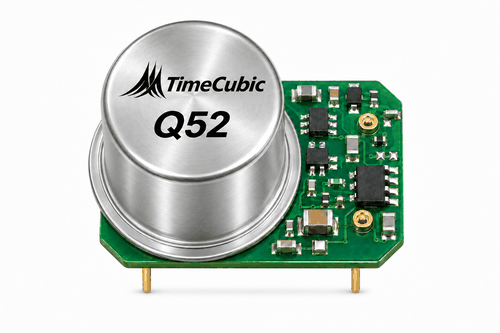
Model Q52
MODEL Q52 SERIES (Q52 & Q52L) ±2 ppb ULTRA-TIGHT STABILITY ±0.3 ppb/g LOW-G

Q52 / Q52L High-Stability Low-G Precision Oscillator

The Q52 series provides mission-critical stability for maritime beacons, search-and-rescue systems, mobile test & measurement, and high-shock seismic deployments. The new Q52L (Rev A, 2026) features 5× tighter temperature stability (±2 ppb), native low acceleration sensitivity (±0.3 ppb/g), and optional 1500G, 1ms mechanical shock survival.
TEMP STABILITY ±2 ppb (Q52L)
G-SENSITIVITY ±0.3 ppb/g typ
SHOCK SURVIVAL Up to 1500G, 1ms
POWER 75–109 mW @ 3.3V
Model Q69
MODEL Q69 SERIES (Q69 & Q69-100M) 30-SEC RAPID WARM-UP 1000G SHOCK • ADAS & LEO

Q69 Wide-Temperature Rapid Warm-Up 1PPS Disciplined Oscillator

The next-generation ruggedized 1PPS disciplined oscillator built for automotive ADAS master clocks, LEO smallsats, and defense payloads. Operates reliably across -40°C to +85°C with rapid 30-second warm-up, hitless 1PPS re-steering, 1000G, 1ms shock survivability, and ultra-low phase noise up to 100 MHz (-175 dBc/Hz floor on Q69-100M).
WARM-UP TIME 30 Seconds (200 mW)
TEMP RANGE -40°C to +85°C
DISCIPLINE ACC 1 ns RMS / <10-12
STEADY POWER 135 mW (-40~+85°C)
Model Q100
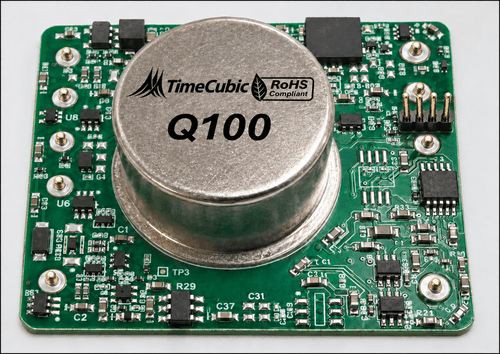
MODEL Q100 SERIES 1PPS DISCIPLINED • <65 mW ±1.0 ms / 60-DAY HOLDOVER

Q100 Flagship 1PPS Disciplined Timing Module

The world's leading timing module for seabed Ocean Bottom Nodes (OBN). Features continuous 1PPS input and 1PPS output disciplining down to 1 ns RMS phase and <10-12 in frequency. The updated Rev O lowers warm-up power by 60% (220 mW) and steady power to <65 mW, with continuous 1-second phase telemetry via RS232 and 64-byte non-volatile user memory.
PHASE RES ≤1 ns RMS
FREQ ACC <1×10-12
HOLDOVER ±1.0 ms / 60 days
STEADY POWER <65 mW @ 25°C
Model Q200
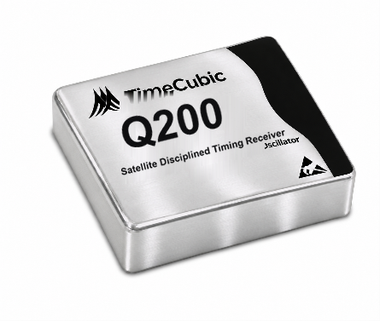
MODEL Q200 SERIES SATELLITE DISCIPLINED • 5G & SMART GRID ±1.0 μs / 24h ADAPTIVE HOLDOVER

Q200 Satellite Disciplined Timing Receiver

Engineered for mission-critical infrastructure including 5G base stations and Smart Grid Substation Phasor Measurement Units (PMU). Employs TimeCubic's proprietary machine learning adaptive holdover algorithm to maintain ±1.0 to ±1.5 μs over 24 hours during GPS loss even across ±5°C ambient temperature fluctuations.

ADAPTIVE HOLDOVER ±1.0 μs / 24h (±5°C)
OUTPUT FREQ 10 MHz (5, 8.192 MHz)
PHASE NOISE <-147 dBc/Hz floor
STATUS PINS Lock & Enable pins
Architectural Benchmark • Low-G & Phase Noise Comparison

TimeCubic SC-Cut Quartz OCXO vs. SiTime MEMS Oscillators

Why defense, tactical airborne, and subsea engineers choose TimeCubic over MEMS timing: matching 0.1 ppb/g acceleration sensitivity while providing >20 dB cleaner phase noise and zero PLL synthesizer jitter.

Specification Parameter TimeCubic Q52 / Q101 (SC-Cut Quartz) SiTime Endura / Elite (MEMS) System Engineering Impact
Acceleration Sensitivity (Γ) <0.3 ppb/g (Standard) / 0.1 ppb/g (Q101 Flight-Grade) 0.1 to 0.5 ppb/g Equal or superior vibration immunity in dynamic environments
Broadband Phase Noise Floor ≤ -175 dBc/Hz (Ultra-Pure Analog Resonance) -145 to -155 dBc/Hz (20 to 30 dB higher noise) Avoids ADC SNR degradation; aperture jitter <50 fs vs >300 fs
Close-In Phase Noise (100 Hz offset) -135 dBc/Hz (10 MHz) • -125 dBc/Hz (100 MHz) -100 to -110 dBc/Hz (Severe 1/f flicker noise) Doppler radar target velocity resolution & weak signal tracking
Synthesizer Spurs & PLL Jitter Zero (Native fundamental overtone SC-cut) Fractional-N PLL spurs & quantization jitter Pure sinusoidal spectrum without spurious mixing products
Short-Term Stability (ADEV @ 1s) 1 × 10-12 1 × 10⁻¹⁰ (100× higher jitter) Critical for subsea acoustic positioning and satellite downlinks
Autonomous 24h Holdover <1.0 to 1.5 μs / 24h (Q200 / Q100) 50 to 500 μs / 24h (ppm-level drift) Multi-day GNSS-denied holdover vs hours for MEMS
Steady Operating Power <60 mW (<45 mW in Model Q100) 35 mW to 150 mW Comparable low power without sacrificing RF phase noise
R&D LAB: NORTH ANDOVER, MA

Need a Custom Frequency or Drop-In Replacement?

We engineer custom frequencies from 5 MHz to 100 MHz, pin-compatible retrofits for discontinued oscillators, and tailored low-G cuts with direct US engineering support.

Product Selection & Technical FAQ

Answers to common engineering questions regarding model selection, holdover, and phase noise.

Which model is recommended for subsea Ocean Bottom Nodes (OBN)? ↓
For free-running nodes where power is the single critical metric, Model Q50 (<60 mW) provides unmatched battery life. For nodes requiring GNSS synchronization prior to immersion and extended 60-day blind holdover (±1.0 ms), Model Q100 is our flagship product, proven in active field deployments across 645 subsea nodes.
How does Model Q52 differ from Model Q50? ↓
While Model Q50 is optimized for ultra-low power (<60 mW) in static seabed environments, Model Q52 / Q52L is designed specifically for dynamic airborne environments, incorporating low acceleration sensitivity (<0.3 ppb/g) and high shock survival (1500g) to prevent vibration-induced phase noise spurs in tactical UAVs and avionics.
Can TimeCubic oscillators be supplied with custom frequencies? ↓
Yes. Beyond standard frequencies (10 MHz, 16.384 MHz, 100 MHz), our North Andover, MA laboratory routinely designs custom crystal cuts from 5 MHz to 100 MHz (including 5M, 8.192M, 20M, 25M, and 50M) with tailored supply voltages and custom pinouts.
How does TimeCubic low-G OCXO compare to SiTime MEMS oscillators? ↓
While SiTime MEMS oscillators achieve low G-sensitivity (0.1 to 0.5 ppb/g) due to their small physical resonator mass, MEMS oscillators suffer from 20 to 30 dB worse phase noise (-145 to -155 dBc/Hz broadband floor vs. -175 dBc/Hz for TimeCubic), high close-in 1/f flicker noise, and spurious phase jitter from internal fractional-N PLL synthesizers. TimeCubic Models Q52 and Q101 match or exceed SiTime's acceleration immunity (0.1 ppb/g flight-grade) while delivering the pristine phase noise purity, 1e-12 Allan deviation, and sub-microsecond holdover of SC-cut quartz—all within a micro-power (<60 mW) envelope.
Can TimeCubic oscillators maintain 1.5 μs holdover over 12 hours and 24 hours? ↓
Yes. Model Q200 is specifically engineered for precision holdover during GNSS jamming or outages. Under constant ambient temperature, Q200 maintains <0.8 μs over 12 hours and <1.0 μs over 24 hours. Under dynamic temperature swings of ±5°C/hr, its adaptive Kalman DSP aging algorithm keeps accumulated time drift strictly below 1.2 μs at 12 hours and 1.5 μs at 24 hours, fully compliant with IEEE C37.118 and ITU-T G.8273.1 Class C standards.